route to
perfect poise
THERE's
more to balancing acts than poise and sharp reflexes. The secret to tasks
such as balancing a stick on the end of your fingertips is random noise
generated by the nervous system. The finding is changing
scientists' views about how the body controls movement.
According to physicist Juan Cabrera of the Institute for Scientific Research in Caracas, Venezuela, and neurologist John Milton of Chicago University, random hand movements correct a stick's wobbles far faster than a person would be able to react to seeing them.
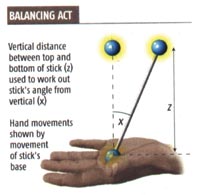
Cabrera and Milton developed the idea by capturing the balancing act on film. By watching light reflected from the ends of the stick they measured the size of the wobbles and correlated them with people's hand movements (see graphic).
According to physicist Juan Cabrera of the Institute for Scientific Research in Caracas, Venezuela, and neurologist John Milton of Chicago University, random hand movements correct a stick's wobbles far faster than a person would be able to react to seeing them.
Cabrera and Milton developed the idea by capturing the balancing act on film. By watching light reflected from the ends of the stick they measured the size of the wobbles and correlated them with people's hand movements (see graphic).
"We
couldn't think of a better experimental paradigm to study how the nervous
system controls balance on short timescales,"
says Milton. They found that although it takes 100 milliseconds for someone
to react to a visual cue like a wobble,
98 per cent of the hand movements used to keep the stick upright
happened faster than that (Physical Review
Letters,
vol 89, p158,702).
To understand the result, the researchers used mathematical equations to describe the motion of the stick, based on ones describing a similar system involving an upright rod pivoting at its base, called an inverted pendulum. They simulated the hand movements by adding a random "restoring force" to their equations. They found that this
To understand the result, the researchers used mathematical equations to describe the motion of the stick, based on ones describing a similar system involving an upright rod pivoting at its base, called an inverted pendulum. They simulated the hand movements by adding a random "restoring force" to their equations. They found that this
therefore be tuned to keep
the stick very close to the point of instability. Random hand movements
in every direction cancel out the wobbles so the stick stays upright,
enabling the body to do a task for which normal reactions would be too
slow.
The finding is causing neuroscientists to rethink their ideas about motor control in
The finding is causing neuroscientists to rethink their ideas about motor control in
random force
was enough to keep the stick upright, making it wobble just like the real
thing - but only if the stick was on the verge of toppling over.
Cabrera and Milton suggest that the nervous system must
Cabrera and Milton suggest that the nervous system must
general. "Our
experiment suggests that the control of movements is organized on the
edges of stability," says Milton. "This is about as big a change
in how one should think about things that I can imagine."